Hamilton Sun & Mon by Appointment
Wellington & Christchurch Trunk Shows Every 3 months

Tux – Suit difference: What are they?

Tux – suit difference: 7 out of every 10 customer come to us claiming they need a suit, one that goes with a bow tie, and much as it is acceptable to accompany a suit with a bowtie, it turned out to be a tux that they actually need. So, what is the difference here? And is there really that many differences between them that we must have two separate pieces for different occasions?

tux, suit, difference, affordable suits, tie, tuxedo tailor made, tailor made suits, ready to wear suits,

Since we’ve actually answered it in several other blog posts, but have never dedicated an article completely to answering this question, today we’re going to talk about the physical, the non-tangible differences, and the exceptions.

231

1/ Tux – Suit Difference: The Intangibles

It’s important to note that, more than just the apparent physical differences, a tuxedo sends a different message than a suit does. Some people tend to wear t-shirts and jeans most of the time and some rarely change out of their sweats. Thus,  it would seem at first that, for any of us who rarely ever dress up, wearing a suit would send just as strong a message as a tuxedo because it’s equally rare.  But it isn’t always the case.

Suits are common ensembles, if not an obligatory outfit for daily work, or as often referred to: a societal norm. On the contrary, the main point of a tux is more than just to dress up. It is about commemorating special occasions, so special you would wear something extraordinary, and otherwise would not elsewhere. That makes the biggest difference, and explains why tux tops the list of clothing choice in such occasions as weddings. You can go to a grocery store picking food for dinner after work in a suit, not a tux. Similarly, you can wear suits to your wedding, that is if you wish to blend in with every other attendees. There is normally no problem to that, just make sure they know you are the groom, the main celebrity of the day.
tux xuit

2/ Tux – Suit Difference: The Physical

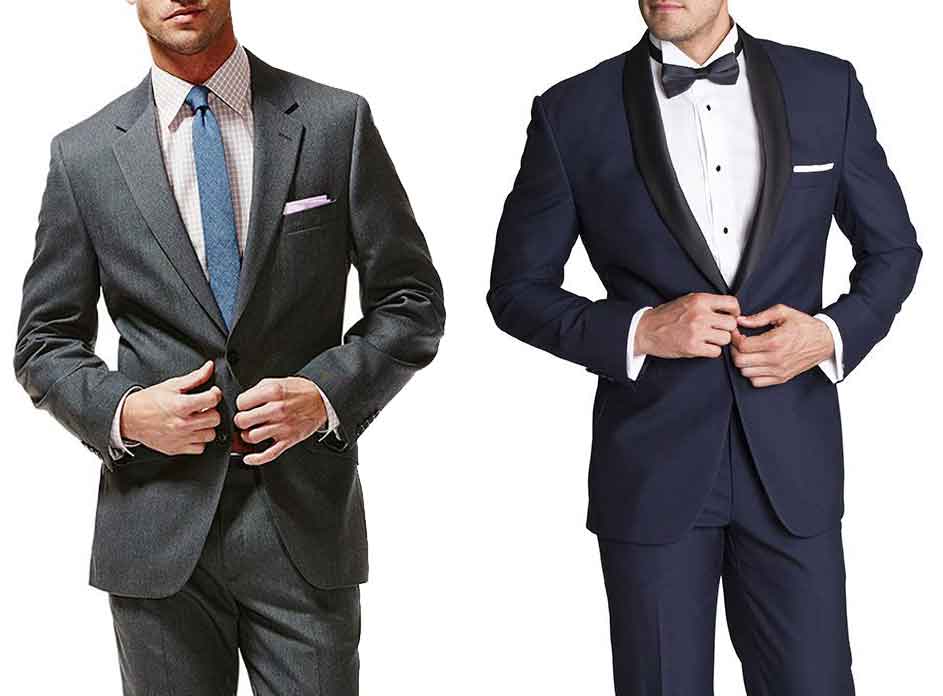
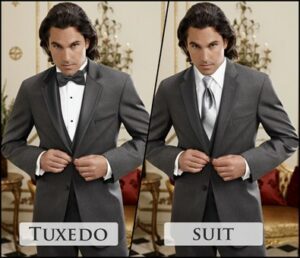
In terms of physical differences, traditionally tuxedos have satin facing on the lapels. Additionally, it sometimes appear on buttons, pocket trim, and a satin side stripe down the leg of the trousers.  Suits don’t incorporate any satin and usually have either plastic or same-fabric-as-the-coat buttons.  Modern tuxedo options have minimized satin to a thin trim on the lapels and a thin bead down the leg. Eventually, the primary difference between the two all boils down to tuxes having satin and suits dont. Of course, to every rule there are exceptions.

Other physical differences like appropriate accessories generally only come into play when talking about traditional black tie standards, although for most modern tuxedo functions like proms and weddings, the lines between what to wear with a tuxedo vs. suit have been blurred. Tuxedos are historically only to be worn with bow ties, cummerbunds or waistcoats , since they complement the shiny satin. It’s common, though increasingly less so, to wear long ties and high stance vests with tuxedos. This is a result of the fact that it is a traditional look, only appropriate with suits.
1

3/ The Exceptions

Talking about exceptions, there are now some modern satin-less tuxedo options exists in a few styles made primarily to cater to a growing demand in the wedding market.  Tuxedo lines make nearly identical tuxedos, but in different colors.  While the black, steel grey, and heather grey tuxedos do incorporate satin, the tan and slate blue do not.  Because they are part of a larger line of identical tuxedos, these are still considered tuxedos and are very popular options for both proms and daytime weddings. However, most of the time guests still opt for tailoring to ensure they look their best in the big day. This is because they don’t tailor the tuxes to any specific or particular measurements.


If you have got either a tux or a suit already, check this post out for more useful tips: http://www.tailormadesuits.co.nz/shirt-tie-suit-combination-2/

Click here for our tuxedo options for suit hire. For made to measure or tailoring, the options are almost endless. Bring along your design when you come to see us.
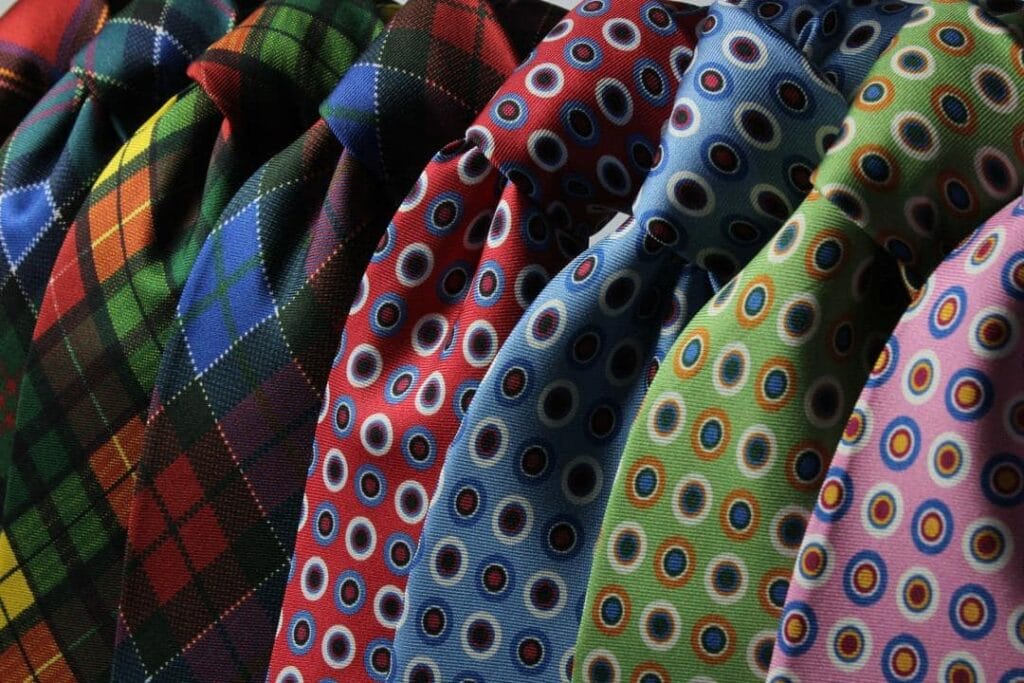
How to Do a Tie

Tying your tie might be a little bit confusing especially if you are not sure in what you are doing. Fortunately, it is easy to learn and master the art of tying a tie. You’ll just need a little patience and your tie can end up as neat as possible.

tie

Follow these steps:

1. Begin by standing in front of a mirror with your tie in hand and the shirt you are wearing buttoned to the top.

2. Now raise your shirt collars and wrap the tie around your neck.

3. Place the thick part of the tie in either left or right hand depending if you are a right or left handed. If you are left-handed use your left hand.

4. Next, locate the seam on the narrow part of the tie, also you can just start with the narrower end hanging about 30.5cm below the wider part of the tie.

5. To tie you need to wrap the thicker end of the tie over the narrower end. The ends should cross each other at the seam on the front of your tie.

6. The next step will be pulling the thicker part of the tie, so that it will be behind the narrower end and then comes around to rest on top of the narrow end of the tie. Repeat this step one more time, and then pull the thicker end through the loop that is around your neck.

7. Pull the thick end of the tie all the way from the knot. Lock it by sliding the knot up the narrower end of the tie, making it straight as you go.

Once you’ve mastered the basic method on tying a tie, you may want to explore and experiment on different kinds of knots. Some of these knots are appropriate for formal occasions and others are for a more casual gatherings. You can even have a tie with dimple. To have a tie with dimple, you just need to do a normal tie, but you need to slide your finger under the knot before you begin to tighten it, squeezing its side just a little. After tightening take your finger out and squeeze the bottom of the knot, by doing this it makes a tiny dimple directly beneath the knot. Finish tying the knot, but you should be careful not messing up your tie dimple. Carefully hold the narrower end of the tie and slide the knot upwards. Finish it by gently fluffing up the fabric on both sides of your dimple. To get regular updates, stay in touch with our blog posts at http://www.tailormadesuits.co.nz/blog

Our experienced tailors

From Hoi An With Love

Hoi An, where our tailors are based, have been famous as a place to get suits from, for a long time. Not many other regions in Viet Nam or elsewhere in Asia that would have a group of tailors specialised in all type of body shapes. They would normally have experience only tailoring clothes for the local people. Out of 10 clients we talked to, about 8 of them would have been there, experienced it and loved it. Or have family and friends that told them about it.

We hand pick our team of tailors who are among the best in Hoi An. And to make sure we have all their dedications, we have our own factory, and our teams only focus on working for our New Zealand operation.

Experience is key

Each experienced tailor we pick is specilised in their own field, so we 5 teams each focus on jacket, trousers, shirts, women wear, and quality control respectively. And with the amount of tourists that came through Hoi An, each of them must have done between 4,000 to 10,000 suits before they can joint our team.

In New Zealand you would not have got many tailor that can claim this sort of experience, given the small population and how expensive bespoke suits are here. So you will be in good hands.

Quick turn around time

In the utmost urgency, an order can be completed within a week or so. Once an order is sent from our head office in Auckland, the purchasing team will source the fabrics and send it over to production teams within a day. It take our master tailors within an hour to cut suit patterns and past it onto the senior tailor teams to sew it together. This process will take about 4-5 hours. The shirts and trousers team will be doing the same thing at their end but this is often faster than suit jacket. Our quality control team will come in to check and if there is no adjustments, it is good to go. We use DHL express and pay a high shipping cost, but normally it would leave Hoi An on Tuesday and arrive in Auckland on Thursday the same week.

Of course, with our backlog of work, and to be conservative and not over promised, our standard time frame would be 4-6 weeks, or urgent orders we would commit to 2-3 weeks.